
Why Anxiety Gets Worse at Night (And What’s Really Happening in Your Brain)
You make it through the day.
You answer emails.
You talk to people.
You function.
Then you lie down.
And suddenly your brain decides this is the perfect time to review every mistake you’ve ever made… and predict every disaster that hasn’t even happened yet.
If anxiety feels stronger at night, you’re not imagining it. And you’re not broken.
There are real biological and psychological reasons this happens.
Let’s break them down without the usual vague advice.
The Day Is Loud. The Night Is Honest.
During the day, your brain is busy.
Even if you’re stressed, you’re distracted:
- Notifications
- Conversations
- Tasks
- Background noise
- Movement
Your mind doesn’t get silence.
At night, that silence finally shows up.
And when external noise drops, internal noise gets louder.
The worries that were pushed aside at 2PM suddenly have a stage at 11PM.
It’s not that anxiety increases.
It’s that there’s nothing left to compete with it.
Your Brain’s “Control Center” Is Tired
There’s a part of your brain responsible for rational thinking and emotional regulation — the prefrontal cortex.
By nighttime, it’s fatigued.
When that happens:
- Emotional centers become stronger
- Logical thinking weakens
- Small problems feel bigger than they are
That email you handled calmly during the day?
At night it turns into “I’m going to lose everything.”
Same issue. Different brain state.
Cortisol Doesn’t Always Behave
Cortisol is your stress hormone.
In a healthy rhythm:
- It peaks in the morning
- It lowers at night
But chronic stress disrupts that pattern.
Some people experience a cortisol bump late at night or around 3–4AM.
That’s why waking up at 3AM with a racing heart is so common.
Your body is preparing for threat… even though you’re safe in bed.
This isn’t weakness. It’s stress physiology.
Suppressed Thoughts Come Back Stronger
If you tell yourself during the day:
“I’ll deal with it later.”
Night becomes “later.”
Your brain doesn’t forget unresolved stress. It stores it.
And bedtime is often the first quiet moment your nervous system has to process it.
That processing can feel like anxiety.
Why 3AM Feels So Intense
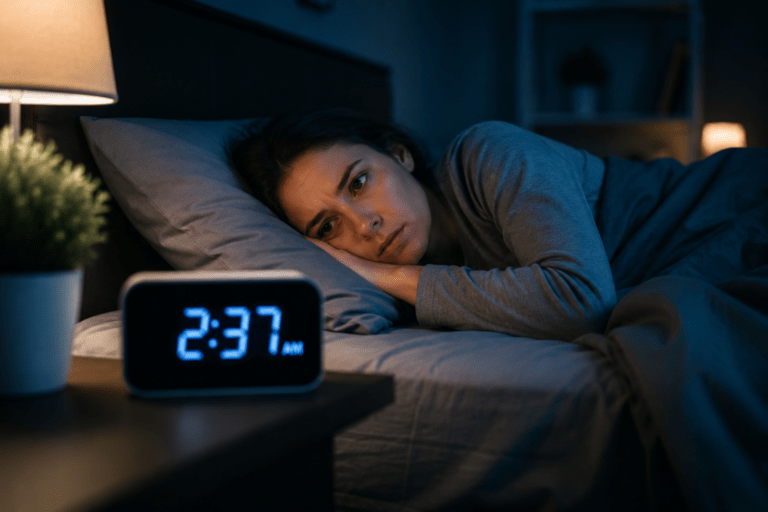
There’s something uniquely brutal about 3AM anxiety.
Here’s why it hits harder:
- Sleep cycles are lighter at that time.
- Body temperature starts rising.
- Cortisol slowly prepares for morning.
- Your environment is dark and silent.
And darkness amplifies perception.
In the daytime, worry feels manageable.
At 3AM, it feels existential.
What Actually Helps (Not Generic Advice)
Let’s skip “just relax.”
Here’s what works in real life.
1. Stop Trying to Force Sleep
When you lie there thinking, “Why am I not asleep yet?” you activate stress.
Instead, change the goal.
Your only job is to rest.
Even lying calmly in the dark counts.
This removes performance pressure.
2. Do a Brain Dump Before Bed
Five minutes. Paper. No structure.
Write everything that’s circling in your mind.
Not a gratitude journal. Not positive affirmations.
Just unload.
Your brain relaxes when it knows the thoughts are stored somewhere safe.
3. Extend Your Exhale
Breathing patterns directly affect your nervous system.
Try this:
Inhale for 4 seconds.
Exhale for 6 seconds.
Slow and steady.
Longer exhales activate your parasympathetic system — your body’s calming response.
Do it for 3–5 minutes.
4. Consider Magnesium (If You’re Deficient)
Magnesium plays a role in nervous system regulation.
Some people with nighttime anxiety find relief using magnesium glycinate before bed.
It’s not magic.
But if stress has been draining you for months, your body may need support.
(Here is where you naturally place affiliate links — inside helpful context, not pushy sales.)
5. Lower Evening Stimulation
Be honest with yourself.
Are you:
- Reading stressful news?
- Arguing in comments?
- Checking work emails?
- Scrolling endlessly?
Your brain cannot go from stimulation to sleep instantly.
Give it a runway.
When It’s More Than Just Stress
If you:
- Fear going to bed
- Wake nightly with panic
- Feel exhausted every day
- Notice worsening mental health
It may be chronic insomnia linked with anxiety patterns.
At that point, structured strategies like cognitive behavioral therapy for insomnia (CBT-I) are far more effective than random tips.
This is something we’ll cover in depth in another guide.
The Real Truth
Night anxiety doesn’t mean you’re weak.
It means:
- You’ve been strong all day.
- You’ve been holding things in.
- Your nervous system hasn’t fully relaxed in a while.
Night simply removes the distractions.
When you understand that, you stop fighting the darkness — and start working with your biology instead of against it.
And that shift alone reduces anxiety more than most quick fixes ever will.