
Why You Feel Sleepy but Your Brain Won’t Shut Off
Your body feels heavy.
Your eyes burn.
You yawn.
You’re clearly tired.
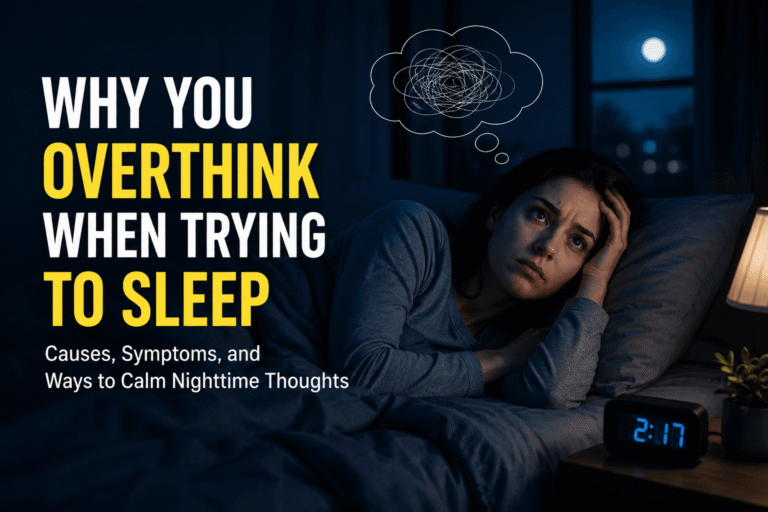
But the moment you lie down, your brain switches on.
Thoughts replay.
Random memories surface.
Future worries grow bigger.
You feel exhausted — yet completely awake.
If this keeps happening, you’re not broken.
And you’re definitely not alone.
There’s a reason for this pattern.
1. You’re Physically Tired but Mentally Stimulated
Your body and brain don’t always operate on the same schedule.
Physical fatigue comes from:
- Movement
- Work
- Long days
- Low sleep
Mental stimulation comes from:
- Screens
- Conversations
- Stress
- Problem-solving
You can be physically drained while your nervous system is still activated.
That’s why you feel sleepy — but not calm.
2. You Didn’t Give Your Brain a “Landing Strip”
Sleep doesn’t happen instantly.
Your nervous system needs transition time.
If you go from:
✔ Scrolling social media
✔ Watching intense shows
✔ Replying to messages
✔ Thinking about tomorrow
Straight into bed…
Your brain hasn’t powered down yet.
It’s like trying to stop a moving car without braking.
3. Stress Hormones Stay Elevated
Even low-level daily stress keeps cortisol slightly elevated.
At night, cortisol should drop.
But if:
- You overthink
- You carry unresolved stress
- You worry about sleep itself
Cortisol doesn’t fall enough.
Your brain stays alert — even when your body is begging for rest.
This is often called being “tired but wired.”
4. You’ve Trained Your Brain to Associate Bed with Thinking
If you frequently:
- Lie awake worrying
- Check the clock
- Scroll in bed
- Think through problems
Your brain learns:
“Bed = thinking time.”
Not “Bed = sleep.”
Over time, this becomes a habit loop.
5. You Fear Not Sleeping
Ironically, the fear of insomnia fuels insomnia.
When you lie down thinking:
“I need to fall asleep now.”
Your body interprets pressure.
Pressure activates alertness.
Alertness blocks sleep.
It becomes a cycle.
What Actually Helps (Practical Steps)
These aren’t generic tips. These work because they calm the nervous system.
1. Create a 30-Minute Wind-Down Rule
No screens.
Dim lights.
No stressful conversations.
Instead:
- Light stretching
- Slow breathing
- Reading something calm
- Writing tomorrow’s to-do list
This gives your brain permission to slow down.
2. Try the “Brain Dump” Method
Before bed, write down:
- What’s bothering you
- What you need to do tomorrow
- What you’re worried about
Not perfectly. Just empty your head.
When thoughts are stored externally, the brain relaxes.
3. Slow Your Exhale
Breathing directly affects your nervous system.
Try:
Inhale 4 seconds
Exhale 6–8 seconds
Longer exhales activate your body’s calming response.
Do this for 3–5 minutes.
4. If You’re Awake Too Long — Get Up
If you’re wide awake for 20 minutes:
Get out of bed.
Low light. Calm activity.
Return only when sleepy.
This retrains your brain to associate bed with sleep — not frustration.
5. Support Your Nervous System
Some people benefit from:
- Magnesium glycinate
- L-theanine
- Glycine
These don’t force sleep — they support relaxation.
(Place affiliate links naturally here if available.)
FAQ
Why am I so tired but can’t sleep?
Because physical fatigue and mental activation are different systems. Your body may be tired while your brain remains alert.
Is this insomnia?
It can become insomnia if the pattern repeats often, but occasional episodes are common during stress.
Should I stay in bed and try harder?
No. Forcing sleep increases alertness. Relaxation works better than effort.
Conclusion
Feeling sleepy but mentally awake isn’t a mystery.
It’s usually:
- Stress that hasn’t settled
- Stimulation too close to bedtime
- A nervous system that hasn’t shifted into rest mode
When you reduce activation before bed, your body and brain finally sync up.
And sleep becomes easier again.